 |
| Tie one on this weekend! www.waltersflyrods.com |

Thursday, September 4, 2014

Wednesday, August 27, 2014

Tuesday, August 19, 2014
Walters Fly Rods in Action - Gary Long On The White River, Arkansas
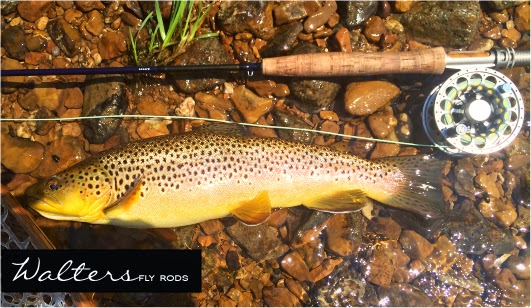 |
| Gary Long checking in again from the White River in Arkansas with this excellent Brown Trout caught using his Walters Fly Rods setup. Thanks Gary for the excellent photo! |
We love seeing our products in action. Submit your photos using your Walters Fly Rods products to info@waltersflyrods.com
Wednesday, August 13, 2014
The Chattahoochee Fly Rod and BT12 Fly Reel
 |
| The Chattahoochee Fly Rod and BT12 Reel. Photo By: David Cannon |
Tuesday, August 5, 2014

Wednesday, July 30, 2014

Wednesday, July 23, 2014

Wednesday, July 16, 2014

Monday, July 7, 2014
What A Skunk Teaches Us
By: Matt Walters
 |
My immediate thought was what in the heck am I doing wrong? Second thought was, what will I tell my buddy upstream and thirdly what great explanation/excuse can I use to make myself look better.
Let's face it, we've all had bad days on the water, some worse than others, but when it comes down to it, how bad can a day on the water be? Sure, you have a streak of good fishing days, weeks, or even years going and suddenly the bottom literally drops out from underneath you. Whether it is Mother Nature's fault or there was too much fishing pressure or possibly the fish just weren't biting, you name it as there are a ton of great excuses out there, but the fact remains.
In that moment as I made my last cast that day I accepted defeat and went on my way. Yes, it's frustrating and yes it makes you question your tactics and skills, but it isn't all that bad.
I told my Dad later that same day that I hadn't caught a fish in a rather depressive tone and he said sincerely with a smile on his face, "well it's better than a swift kick to the ass." I laughed for a little bit and realized, he's right. Here you are on a beautiful stretch of water with excellent scenery doing what you love and something as small as not catching a fish can ruin it for you.
This got me to thinking, is it only about the fish or is about the experience while out there? I had to back up and think about my Dad's comments. I think we as anglers get caught up in numbers and catching (for good reason, it's fun) that we forget to stop and smell the roses along the journey and actually realize our surroundings, the landscape, the birds, and other species we encounter while fishing. I'm not saying that catching fish does not bring the ultimate joy, but we should allow ourselves moments during the day to just sit on the bank and breathe it all in.
The next day I headed out again with a refreshed attitude of enjoying the entire experience and ended up landing a few decent fish (nothing spectacular), but "it was better than a swift kick to the ass."
Friday, July 4, 2014

Friday, June 27, 2014
Walters Fly Rods in Action - John Duisberg with a Davidson Rainbow
 |
| John Duisberg with a nice Davidson River Rainbow Trout. Photo by: Ken Hardwick |
Friday, June 20, 2014
Pack The Rods, Reels, And Cooler. It's Time For the Weekend!
 |
| Photo by: Ken Hardwick |
Matt Wilson enjoys a cold one in his Walters Fly Rods Koozie back at the truck along the Davidson River, NC.
Wednesday, June 11, 2014
Mr. Goldeneye


I recently took a trip to the beach near Charleston, SC and pulled out the kayak to hit the creek on a low tide. I unfortunately spooked a lot of fish that I couldn't see while paddling until it was too late and they were under the boat. I docked the kayak and headed to a wading spot where I was able to capitalize using a copper flash clouser pattern. The tide was high, the grass was flooded, and the fish were biting. The saltwater demo is performing perfectly.
Sunday, May 25, 2014

Wednesday, May 21, 2014
The 10 Cent Leader Caddy Using Pipe Insulation
by Matt Walters
 |
| 10 Cent Leader Caddy Using Pipe Insulation |
I saw this great idea on the internet the other day while looking for solutions to the tangled mess of used and new leaders in my pack. This isn't rocket science and some of you may already be using this idea for your leaders. This cheap solution to my messy pack works incredibly well for the cost. The 6 foot section of pipe insulation allows you to make many of these leader caddies and stay prepared on the water with multiple pre-rigged leaders ready for your use. Go out and give it a try.
Steps to make your own Leader Caddy:
- Purchase a 6 foot section of 1.25 inch thick pipe insulation with the connecting adhesive already installed. I purchased mine from a hardware store for only $1.50, so the 4 inch section in the picture costs roughly 10 cents.
- Using an X-ACTO knife cut a section of pipe insulation roughly 4 inches in length from the entire piece. You can make the leader caddy as big or as small as you require for your pack.
- Using the X-ACTO knife again, Cut slits into the outside diameter of the pipe insulation where the leaders can drop down below the surface so they stay in place. Be sure to cut shallow and not all the way through to the center of the pipe insulation otherwise the leaders will slide through.
- Next, if your pipe insulation comes with adhesive, remove the protective layers and seal the two sides of the pipe insulation together. Otherwise you will need to apply an epoxy to seal and connect the seam of the pipe insulation.
Thursday, May 15, 2014
Walters Fly Rods In Action - North Georgia Rainbow Caught By Matt Wilson
.JPG) |
| Matt Wilson with a big rainbow caught in a North Georgia creek using his Walters Fly Rods setup |
Wednesday, May 7, 2014

Thursday, May 1, 2014
Selecting A Fly Rod For Trout
By Matt Walters
 |
| Ken Hardwick lifting a Trout to the water's surface with the Walters Fly Rods 9' 5WT. Photo by David Cannon |
So we'll start off with the fly rod. Some of the below information is extremely obvious to those who have been fly fishing for a while. On the other hand, I hope some of the newer members to this sport will pick up some new knowledge. My ultimate goal with this post is to help the beginner become educated on their first fly rod purchase for trout fishing.
WT:
For trout fishing you can choose from a variety of different fly rods with different weights and lengths. The most typical trout rod out there with the most versatile applications is the standard 9' 5WT 4 Piece. This is why I chose this rod as my first rod offering for my company as it fits the mold for pretty much anything related to freshwater trout. The weight (WT) of a fly rod is not the weight in ounces it is actually determined by the diameter of the fly rod and the ability to handle particular weight loads (ie fish and flies). The higher the "WT" number the bigger fish it can catch and the larger flies it can cast with ease. The choices in the weight of the fly rod can vary for trout fishing from around a 3WT for small streams, smaller fish, and delicately placing small flies to the other extreme, a 7WT for throwing huge streamers and targeting big heavy fish. The 5WT fits snugly in the center of these two rod weights and can handle both of these situations very well.
LENGTH:
The length of the fly rod will also help you in many ways while fly fishing for trout. A longer fly rod (9'-10') will give you more reach and allow you to high stick and put the flies further out away from your body with little to no casting required. The longer fly rod will also make mending the line and roll casting (a necessity on many streams) much easier. A shorter fly rod (7'-8.5') will allow you to cast more freely in tighter quarters as the rod will not interfere with overhanging branches or bushes. Shorter fly rods also offer more accuracy at short to medium distances. You will get more casting distance out of a longer fly rod with less effort than a shorter fly rod, but distance doesn't always equal success in trout fishing. My choice has always been with a 9' or 8.5' rod although shorter rods are very fun especially in smaller weight sizes.
ACTION:
The action of a fly rod is a lot about personal preference. I personally like a fast action rod, but I suggest trying various actions out. There are a few different actions available out there. Slower action fly rods have a subtle and progressive taper from rod tip to the cork grip by design and will give you more "touch" when fishing small streams. The action of this progressive taper will slowly and delicately lay flies on the water as the action of the rod bends deeper towards the cork handle of the rod. The slow action fly rod, due to its less stiff characteristics, will give much more cushion when actually hooking and playing a fish especially when using finer tippets and lines. On the other hand, fast action rods will give more distance and spring as the rod bends on a steeper taper that is located much closer to the rod tip. Faster action fly rods are much more suitable for windy conditions, double hauling, and single hauling. Both actions are equally important in different scenarios. Just to clarify, a fast action fly rod can be used to cast slowly and to achieve a delicate presentation, it just takes slightly more precision on the angler's part. The middle ground here is a mid action fly rod which has a taper design built to bend more towards the center of the rod offering a compromise to both of the other actions described above.
REEL SEAT & CORK HANDLE:
The reel seat and cork handle are important as well as they can effect the balance of the fly rod. The cork handle should feel comfortable in your hand and provide you with a firm grip that allows you complete control over the fly rod. The cork grip should feel like a seamless connection point between your arm and the fly rod. I would suggest purchasing a AAA grade cork handles as it will be smoother to the touch and will endure the test of time much better. The trout fishing reel seat can come in a few different styles in anodized aluminum with wood inserts and various ways to secure the reel to the fly rod. My favorite is a burl wood insert and an up locking reel securing system.
GUIDES:
The guides on a fly rod are important as well. Typically a fly rod will have a total number of guides equal to the length of the fly rod in feet. This can vary as some 9' fly rods have a total of 10 guides. The major things you want to ensure regarding fly rod guides is that the epoxy was applied correctly and that the entire guide foot and all wraps that hold it in place are covered. The guides should also be in a straight line along the entire rod and in the correct relation to the spine of the rod if you want to get technical. Guides are made of either titanium or steel while the majority are of the latter material. The first guide(s) past the cork handle are referred to as stripping guides and should feature a ceramic coating on the inside where the line runs through which creates a slick friction-less area for your line to travel through.
OVERALL FEEL:
Overall the most important thing to consider when purchasing your first fly rod is the actual feel of the rod. Does it feel heavy? Will I be able to cast and carry this all day comfortably? Does the fly rod feel secure and balanced when holding it and casting it (not too heavy on one end or the other)? The above details will hopefully help you narrow down your search, but the reality is unless it feels good it doesn't matter what the specs are. I once heard that fly rods and fly rod building are like cooking food. You can make the best recipe on paper, but unless it tastes good it isn't worth a darn. One last factor to consider is to pick a fly rod that is aesthetically pleasing to you. You will be spending a lot of time with your new equipment and possibly passing it on to someone else in the future. Make the choice that feels right to you.
We will go into more fly fishing topics for the beginner on later posts so please stayed tuned and let us know if you have any suggestions. There is a lot of information above and there are some significant differences especially in the action, length and WT of a fly rod.
If anyone has any questions regarding a fly rod or fly rod purchase please do not hesitate to ask me via a comment below or email your questions to info@waltersflyrods.com. I will gladly help out. In addition, if you feel I have left anything out that you consider important feel free to add via the comments section below.
If anyone has any questions regarding a fly rod or fly rod purchase please do not hesitate to ask me via a comment below or email your questions to info@waltersflyrods.com. I will gladly help out. In addition, if you feel I have left anything out that you consider important feel free to add via the comments section below.
Friday, April 25, 2014
Walters Fly Rods' Hats, Koozies, and Decals

We now have hats, koozies, and decals available for purchase on the website. Check them out now at www.waltersflyrods.com
Thursday, April 17, 2014
Walters Fly Rods in Action - Another Great Rainbow Caught by Gary Long
 |
| Gary Long with another nice Rainbow using his Walters Fly Rods set up |